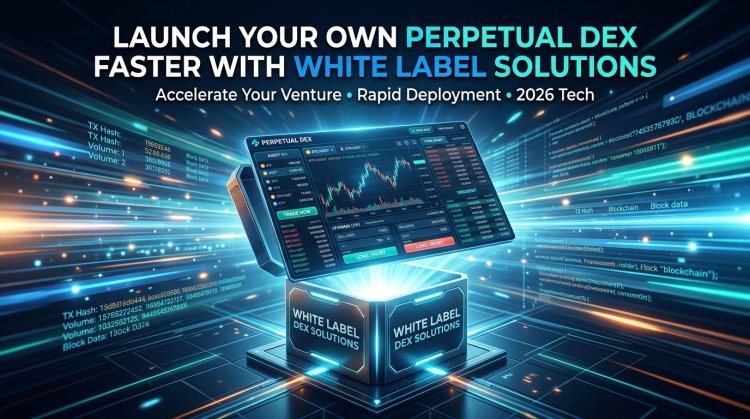
Launch Your Own Perpetual DEX Faster with White Label Solutions
 Alexeidj
Decentralized finance (DeFi) has fundamentally transformed how digital assets are traded, borrowed, and invested. Among the most influential innovations within this ecosystem are Perpetual Decentralized Exchanges (Perpetual DEXs), which enable traders to speculate on cryptocurrency prices using perpetual futures contracts without relying on centralized intermediaries. Unlike traditional futures, perpetual contracts have no expiration date, making them one of the most popular financial instruments in crypto markets.
As institutional participation in digital assets grows and retail traders increasingly seek secure, transparent trading platforms, the demand for perpetual DEXs continues to accelerate. However, developing a sophisticated perpetual trading platform from the ground up requires extensive technical expertise, substantial financial investment, and months or even years of engineering effort.
This challenge has fueled the rise of white label perpetual DEX solutions, allowing entrepreneurs, exchanges, fintech companies, and blockchain startups to launch fully functional perpetual trading platforms within a significantly shorter timeframe. Rather than building every component independently, businesses can deploy a customizable, production-ready infrastructure that dramatically reduces development risks while maintaining complete branding control.
This article explores how white label perpetual DEX solutions simplify market entry, the essential features they offer, their business advantages, and the factors organizations should evaluate before selecting a technology partner.
Understanding Perpetual DEX Platforms
A perpetual decentralized exchange facilitates the trading of perpetual futures contracts through blockchain-based smart contracts rather than centralized order management systems. These platforms eliminate the need for custodial asset storage, allowing users to retain control over their funds throughout the trading process.
Unlike conventional cryptocurrency exchanges that require users to deposit assets into centralized wallets, perpetual DEXs execute trades through decentralized protocols while maintaining transparency and auditability on-chain or through hybrid architectures.
Most modern perpetual DEXs incorporate several sophisticated mechanisms, including:
- Leveraged trading
- Automated liquidation engines
- Cross-margin and isolated-margin systems
- Decentralized price oracles
- Funding rate mechanisms
- Risk management modules
- Liquidity aggregation
- Multi-wallet compatibility
The popularity of platforms such as GMX, dYdX, Hyperliquid, and Vertex demonstrates that traders increasingly value self-custody, transparency, and permissionless access without sacrificing professional-grade trading functionality.
According to multiple industry reports, decentralized derivatives trading has experienced exponential growth over the past few years, with billions of dollars in monthly trading volume moving through perpetual DEX protocols. This trend indicates that decentralized derivatives are becoming an integral segment of the broader digital asset market.
Why Building a Perpetual DEX from Scratch Is Challenging
Launching a perpetual DEX involves much more than developing a user interface. It requires building an entire financial ecosystem capable of processing thousands of transactions securely while managing significant market risks.
Key technical components include:
- Smart contract architecture
- Matching engine or virtual AMM infrastructure
- Oracle integration
- Margin calculations
- Liquidation mechanisms
- Risk engine
- Funding rate calculations
- Multi-chain compatibility
- Wallet integrations
- Security audits
- Liquidity management
Each subsystem must function flawlessly because even minor vulnerabilities can result in significant financial losses.
Security is another major consideration. Blockchain exploits have collectively resulted in billions of dollars in losses over recent years, highlighting the importance of rigorous smart contract testing, penetration assessments, and multiple independent audits.
Furthermore, attracting liquidity presents an equally difficult challenge. A technically robust exchange cannot succeed without sufficient market depth. Building partnerships with market makers, liquidity providers, and institutional traders often takes considerable time and resources.
Consequently, businesses seeking rapid market entry frequently choose white label platforms instead of investing heavily in lengthy development cycles.
What Is a White Label Perpetual DEX Solution?
A white label perpetual DEX is a pre-built, customizable trading infrastructure developed by specialized blockchain technology providers. Rather than creating every component internally, businesses license the software and personalize it according to their branding, operational requirements, and target audience.
The technology provider typically supplies:
- Complete trading infrastructure
- Smart contracts
- Trading engine
- Wallet integration
- Risk management tools
- Admin dashboard
- Liquidity connectivity
- Technical maintenance
- Security updates
The client customizes branding, token listings, supported blockchain networks, fee structures, and user experience while maintaining ownership of the platform's business operations.
This model significantly shortens deployment timelines, enabling organizations to focus on customer acquisition, partnerships, liquidity growth, and business expansion instead of complex software engineering.
Key Features of Modern White Label Perpetual DEX Solutions
Not all white label platforms offer the same capabilities. The most competitive solutions provide enterprise-grade functionality comparable to established exchanges.
Advanced Trading Engine
Professional traders expect low latency, fast order execution, and reliable performance during periods of market volatility.
A high-quality perpetual DEX should support:
- Market orders
- Limit orders
- Stop-loss orders
- Take-profit functionality
- Partial order execution
- High-frequency trading support
Efficient execution minimizes slippage while enhancing trader confidence.
Multi-Chain Compatibility
The blockchain ecosystem is increasingly fragmented across networks such as Ethereum, Arbitrum, Optimism, Base, BNB Chain, Polygon, Avalanche, and Solana. Modern white label solutions often support multiple chains, enabling users to trade from their preferred ecosystem.
Multi-chain functionality also broadens market reach and increases available liquidity.
Integrated Wallet Support
Users increasingly expect seamless connectivity with popular wallets.
Typical integrations include:
- MetaMask
- WalletConnect
- Coinbase Wallet
- Trust Wallet
- Phantom
- Rabby
These integrations simplify onboarding while preserving users' self-custody.
Liquidity Infrastructure
Liquidity determines trading quality.
Leading providers offer:
- Liquidity aggregation
- Market maker integrations
- Shared liquidity pools
- Cross-chain liquidity
- Automated market-making support
Adequate liquidity improves execution quality while reducing price impact.
Robust Risk Management
Perpetual trading carries inherent financial risks.
Modern solutions incorporate:
- Automated liquidations
- Margin monitoring
- Insurance fund management
- Dynamic leverage limits
- Circuit breakers
- Risk analytics
These mechanisms protect both traders and platform operators from cascading market failures.
Business Advantages of White Label Solutions
Faster Time to Market
Developing a perpetual DEX internally can take anywhere from 12 to 24 months depending on complexity.
White label solutions can often reduce implementation timelines to several weeks or a few months, allowing businesses to capitalize on emerging market opportunities before competitors.
In fast-moving cryptocurrency markets, speed frequently becomes a decisive competitive advantage.
Lower Development Costs
Building an exchange requires hiring blockchain developers, backend engineers, frontend developers, DevOps specialists, UI designers, cybersecurity experts, quality assurance teams, and project managers.
A white label platform eliminates much of this expense by leveraging infrastructure that has already been designed, tested, and refined.
Instead of allocating millions toward engineering, businesses can redirect resources toward:
- Marketing
- Community development
- Liquidity incentives
- Customer support
- Strategic partnerships
Proven Technology
White label platforms generally undergo extensive testing across multiple deployments.
Rather than experimenting with untested code, businesses benefit from infrastructure that has already demonstrated stability under real trading conditions.
This significantly reduces operational risk.
Scalability
As trading activity grows, infrastructure must accommodate increasing transaction volumes.
Enterprise-grade white label providers typically design their architecture to scale efficiently through cloud deployment, modular microservices, and optimized blockchain integrations.
Businesses can expand without rebuilding their core platform.
Customization Without Starting from Zero
One common misconception is that white label software limits flexibility.
Modern providers offer substantial customization across several areas.
Businesses can personalize:
- Brand identity
- Interface design
- Supported cryptocurrencies
- Blockchain networks
- Trading fees
- Referral systems
- Loyalty programs
- Native utility tokens
- Governance mechanisms
- KYC configurations
- Regional language support
This enables companies to differentiate themselves while benefiting from pre-built infrastructure.
For example, one platform may target institutional derivatives traders with sophisticated analytics, while another focuses on beginner-friendly perpetual trading with simplified interfaces and educational resources—all powered by the same underlying technology.
Security and Compliance Considerations
Security remains one of the most important evaluation criteria when selecting a white label provider.
Businesses should prioritize vendors offering:
- Independent smart contract audits
- Multi-signature wallet support
- Cold storage compatibility
- DDoS protection
- Continuous monitoring
- Bug bounty programs
- Encrypted communications
- Secure key management
Compliance is equally significant.
Depending on operating jurisdictions, exchanges may require:
- KYC procedures
- AML monitoring
- Transaction reporting
- Risk disclosures
- Data privacy compliance
- Licensing support
Although decentralized exchanges typically reduce custodial responsibilities, regulatory expectations continue evolving worldwide. Choosing a provider familiar with international compliance standards can simplify future expansion.
Conclusion
As decentralized derivatives continue to reshape the future of digital asset trading, launching a robust and feature-rich perpetual DEX has become a strategic opportunity for businesses looking to enter the DeFi ecosystem. While building such a platform from scratch demands significant time, expertise, and investment, white label solutions offer a faster, more cost-effective path to market without compromising on scalability, security, or customization. By leveraging proven infrastructure, businesses can focus on user acquisition, liquidity growth, and innovation while reducing technical complexities. For organizations seeking a trusted technology partner, Blockchain App Factory, a leading Perpetual DEX Development Company, delivers comprehensive end-to-end development solutions, enabling businesses to launch secure, scalable, and fully customized perpetual decentralized exchanges that are built for long-term success in the evolving Web3 landscape.