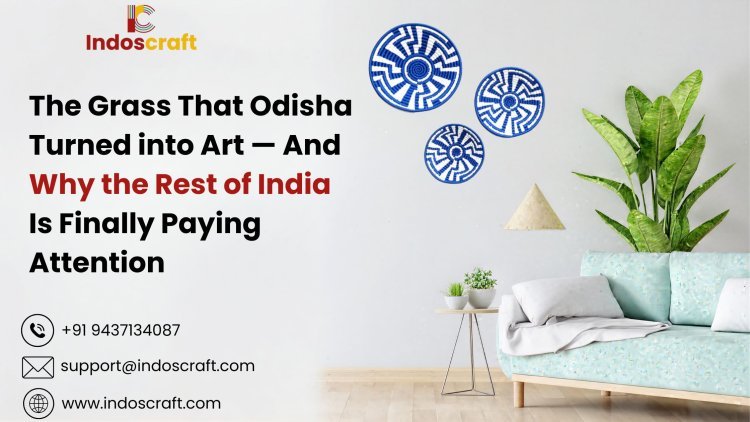
The Grass That Odisha Turned into Art — And Why the Rest of India Is Finally Paying Attention
Indoscraft approaches sabai grass products differently — sourcing directly from artisan communities in Odisha in ways that keep the commercial relationship honest.
 Indoscraft
There is a village in Odisha where women wake before dawn and begin weaving.
Not because someone told them to. Not because a factory whistle blew. Because the sabai grass was cut the previous evening and needs to be worked while it still holds moisture, while it is still cooperative, still willing to bend without breaking. This knowledge lives in hands, not books. Passed from grandmother to daughter to granddaughter across generations that never thought to write it down because writing it down would miss the point entirely.
That grass. That specific weaving. That specific knowledge — this is what arrives when someone orders sabai grass products online today.
Which means the least interesting thing about these products is that they look good on a shelf.
What Sabai Grass Actually Is
Sabai grass grows wild across the forests of Odisha, Jharkhand, and parts of West Bengal. Tough enough to survive the dry season. Flexible enough to be twisted, coiled, braided, and woven into forms that hold their shape for years.
Tribal communities — particularly in Odisha's Bargarh and Sambalpur districts — have worked with sabai grass for centuries. Baskets, mats, storage boxes, wall hangings, trays, and decorative containers. The raw material costs almost nothing. The skill costs everything.
This is the paradox of sabai grass handicrafts. The product that arrives in someone's living room in Bangalore or Mumbai started as wild grass and was transformed entirely by human skill, patience, and a cultural inheritance that no manufacturing process can replicate.
Why These Products Feel Different
Most home décor products are designed to look handmade.
Sabai grass handicraft items are handmade, and the difference is something people feel immediately, even when they cannot articulate it precisely. The slight variation in coiling. The texture under fingertips that machine-finished surfaces never produce. The way light falls differently on a woven surface than on a molded one.
There is also something else. Something harder to name.
Buying a sabai grass basket or a woven tray is not a neutral transaction. It connects the buyer — whether they think about this consciously or not — to a specific place, a specific community, a specific set of hands that worked through an early morning to produce this particular object. That connection is not marketing language. It is what craft actually is.
What Indoscraft Gets Right About This
Most platforms that sell handicrafts treat them like any other product category. Photographs. Specifications. Add to cart.
Indoscraft approaches sabai grass products differently — sourcing directly from artisan communities in Odisha in ways that keep the commercial relationship honest. The weavers receive fair prices. The products that arrive at buyers' homes have not passed through enough intermediaries to make the origin story meaningless.
The range covers sabai grass handicraft items across home décor, storage, gift, and decorative categories — baskets in various sizes, coiled trays, wall art, and table accessories. Each piece varies slightly from the next because each piece was made by a specific person on a specific morning.
That variation is not a quality control problem. It is the entire point.
When someone chooses to buy Sabai grass products online through Indoscraft, they are not just purchasing home décor. They are participating — however indirectly — in keeping alive a craft tradition that has no factory backup plan. If the buyers disappear, the weavers move on to other work. The knowledge does not get preserved in a museum. It simply stops being passed down.
The Last Bit
The sabai grass products sitting in Indoscraft's catalogue were made by someone whose grandmother taught there, who taught her. That inheritance travelled across decades without a curriculum, without a certification, without anything except the decision to keep doing it because it was worth doing.
Buying one of these pieces does not save a craft tradition by itself. But it contributes to an economic reality where continuing is more viable than stopping.
That is worth something. Probably more than the price tag suggests.
Indoscraft is where that purchase makes the most direct difference — browse the range before the next gifting occasion decides for you.
FAQs
1. What makes Sabai grass products different from regular woven products?
The material and method both. Sabai grass has a natural texture and flexibility that machine-processed materials cannot replicate. Weaving techniques refined across generations produce a finish and character that mass-produced alternatives simply do not possess.
2. Are sabai grass handicraft items durable enough for daily use?
More durable than most buyers expect. Sabai grass is naturally tough — woven properly, baskets and trays handle regular use well for years. Just keep them away from prolonged moisture and harsh direct sunlight.
3. Can sabai grass products be used as gifts?
Exceptionally well. The combination of craft heritage, practical utility, and distinctive aesthetics makes them memorable in ways mass-produced gifts are not. Indoscraft's range suits corporate gifting, wedding favors, and personal occasions equally.
4. How do I buy Sabai grass products online without compromising quality?
Source from platforms working directly with artisan communities rather than resellers. Indoscraft sources directly from Odisha's weaving communities — the most reliable quality assurance available for genuinely handmade products.
5. Why choose Indoscraft specifically for Sabai grass handicrafts?
Direct artisan sourcing, fair pricing throughout the supply chain, and genuine craft diversity in the catalogue. Pieces vary slightly from each other because they are made individually — the most honest indicator that what is being sold is actually what it claims to be.