Kevin McCarthy & David Gibson-Moore on Sovereign Debt at AIM Summit Dubai
Explore key insights from Kevin McCarthy and David Gibson-Moore at the AIM Summit Dubai. The roundtable sheds light on global sovereign debt, economic volatility, political polarization, and the EM-ification of the US.
 nikita4545
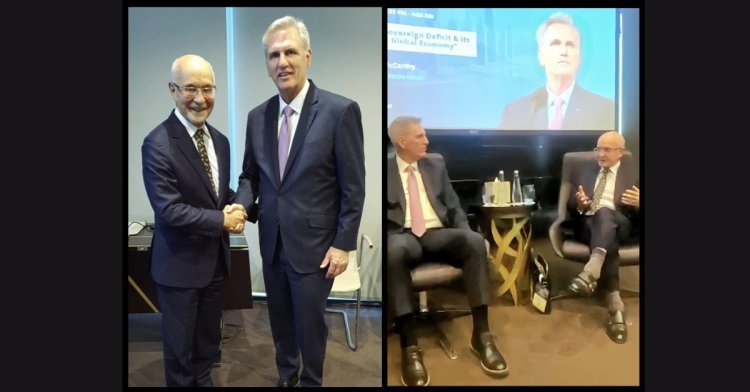
Kevin McCarthy & David Gibson-Moore on Sovereign Debt at AIM Summit Dubai
At the heart of the global economic conversation stands one critical issue: sovereign debt. The AIM Summit in Dubai recently hosted an exclusive roundtable discussion chaired by David Gibson-Moore and featuring Kevin McCarthy, the 55th Speaker of the US House of Representatives. The session offered unparalleled insights into the growing complexities of sovereign debt, political polarization, and the volatile nature of today’s global economic landscape.
A Defining Moment for Sovereign Debt
Sovereign debt has evolved from a regional problem into a looming global crisis. Countries across continents are grappling with unprecedented levels of public debt, exacerbated by inflation, rising interest rates, and inconsistent fiscal policies. Kevin McCarthy underscored this transformation during the summit, noting that excessive government borrowing is no longer confined to developing nations — it's now a defining challenge even for major economies like the United States.
David Gibson-Moore added that the scale of today’s sovereign debt is unparalleled, and without significant reforms in fiscal governance, the risk of a cascading debt crisis remains high. They highlighted that institutions need to embrace long-term strategies focused on fiscal discipline, sustainable growth, and transparent monetary policies.
The Polarization Paralysis
Another key issue that emerged from the roundtable was political polarization in Western democracies. McCarthy candidly addressed the decline of bipartisan cooperation, pointing out how the deepening divide between political ideologies is crippling legislative progress and eroding institutional trust.
He emphasized that centrism, once the foundation of democratic governance, is now at risk of extinction. Political gridlock and extreme partisanship are leading to legislative inertia, where critical decisions about fiscal responsibility and national security are delayed or politicized beyond repair.
Gibson-Moore echoed this sentiment, urging for immediate reforms that promote cross-party collaboration, reduce confirmation bias, and enable leaders to work toward national consensus rather than political gain.
EM-ification of the US: An Alarming Trend
One of the most compelling themes from the discussion was the concept of “EM-ification” — a term used to describe the increasing resemblance of the United States to an emerging market. Originally coined by Mark Rosenberg of GeoQuant, the term points to troubling parallels between the US and economies traditionally viewed as unstable or underdeveloped.
While the US boasts rich natural resources, technological innovation, and agricultural prowess, McCarthy pointed out that it also suffers from institutional fragility, growing political violence, and economic unpredictability — characteristics long associated with emerging markets.
This dual identity raises questions about the long-term stability of the US economy and its ability to lead global markets in a time of increasing complexity and uncertainty.
Emerging Markets: Challenges and Resilience
As discussions turned to emerging markets, both speakers highlighted that while these regions face considerable challenges, they also show remarkable resilience. Gibson-Moore pointed to examples in Southeast Asia and Latin America where structural reforms have enabled economies to recover from repeated financial shocks.
Kevin McCarthy emphasized that the global economic power map is shifting. Many emerging markets are becoming innovation hubs, with young, tech-savvy populations driving growth. However, they also remain vulnerable to external shocks, from global interest rate fluctuations to geopolitical instability.
The takeaway? Emerging markets should not only be viewed as risky but also as strategic opportunities for investment, provided policies are in place to ensure transparency and sustainability.
Leadership in Times of Uncertainty
Perhaps the most powerful message from the roundtable was the urgent need for strong, accountable leadership. As the world navigates multiple crises — from debt burdens to digital disruption — McCarthy called on global leaders to embrace pragmatism, inclusivity, and long-term vision.
He warned that reactive governance and short election cycles often prevent leaders from tackling deep-rooted issues like income inequality, education gaps, and institutional decay.
David Gibson-Moore concluded the session by emphasizing the value of foresight and diplomacy. Leaders who rise above partisanship, engage with data, and prioritize societal welfare over personal agendas will be the ones to guide their countries — and the world — toward stability and prosperity.
The Road Ahead: What to Watch
The AIM Summit roundtable ended with an air of cautious optimism. Despite the gravity of the issues discussed, McCarthy and Gibson-Moore both expressed hope that dialogue, diplomacy, and strategic reforms could help steer the global economy away from a prolonged crisis.
In particular, the upcoming US elections were highlighted as a bellwether moment not just for American democracy, but for global markets and geopolitical dynamics. The choices made in the months ahead will shape policies on sovereign debt, trade, climate change, and international alliances for years to come.
Final Thoughts
The conversation between Kevin McCarthy and David Gibson-Moore at the AIM Summit in Dubai was a masterclass in economic and political foresight. From sovereign debt and political dysfunction to the EM-ification of the US, the insights shared were both sobering and essential.
In a world increasingly shaped by volatility and uncertainty, such platforms of dialogue are invaluable. They don’t just identify problems — they plant the seeds of potential solutions that governments, institutions, and individuals can begin to act on.
Stay tuned for more highlights from the AIM Summit and other global forums shaping tomorrow’s financial and political landscape.