AI Data Collection for Healthcare: Best Practices for Better Results
The healthcare industry is experiencing a major transformation driven by artificial intelligence (AI). From improving patient outcomes to streamlining hospital operations, AI is helping organizations make smarter, faster decisions. However, the success of any AI initiative depends on one critical factor: high-quality data. AI Data Collection for Healthcare plays a vital role in ensuring that machine learning models deliver accurate, reliable, and actionable insights.
 vanessajaminson
The healthcare industry is experiencing a major transformation driven by artificial intelligence (AI). From improving patient outcomes to streamlining hospital operations, AI is helping organizations make smarter, faster decisions. However, the success of any AI initiative depends on one critical factor: high-quality data. AI Data Collection for Healthcare plays a vital role in ensuring that machine learning models deliver accurate, reliable, and actionable insights.
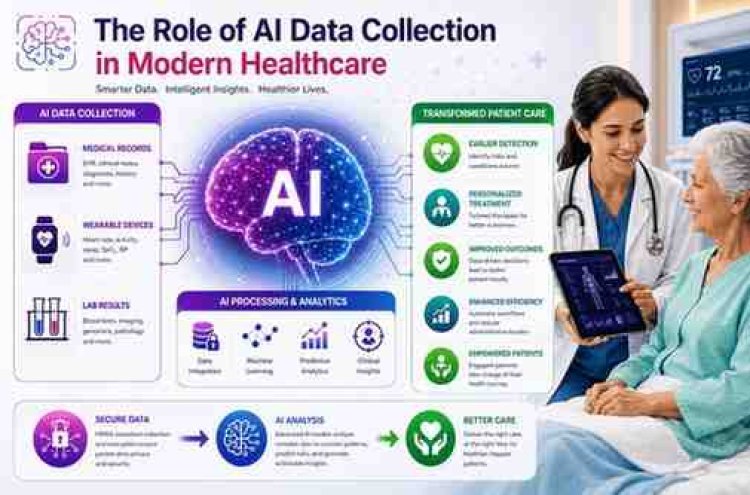
Healthcare organizations across the United States generate enormous volumes of structured and unstructured data every day, including electronic health records (EHRs), medical imaging, laboratory reports, wearable device data, insurance claims, and physician notes. Collecting, organizing, and managing this information correctly is essential for developing AI systems that improve patient care while maintaining regulatory compliance.
In this guide, we'll explore the best practices for AI data collection in healthcare and how organizations can maximize the value of their healthcare data.
Why AI Data Collection for Healthcare Matters
Artificial intelligence depends entirely on data. The better the quality of the data, the more accurate the AI models become. Poor-quality, incomplete, or biased datasets can lead to incorrect diagnoses, inefficient workflows, and poor patient outcomes.
Effective AI Data Collection for Healthcare enables organizations to:
- Improve diagnostic accuracy
- Support predictive analytics
- Enhance personalized treatment plans
- Reduce operational costs
- Detect diseases earlier
- Optimize hospital resource management
- Accelerate medical research
As healthcare providers increasingly adopt AI-powered solutions, robust data collection strategies become a competitive advantage.
Best Practices for AI Data Collection for Healthcare
1. Prioritize High-Quality Data
Quality should always come before quantity. AI systems perform best when trained on accurate, complete, and consistent datasets.
Healthcare organizations should:
- Eliminate duplicate records
- Validate patient information
- Correct missing values
- Standardize medical terminology
- Regularly audit data quality
High-quality datasets reduce errors and improve model performance across clinical applications.
Ensure HIPAA Compliance and Data Privacy
Protecting patient privacy is a legal and ethical responsibility.
When implementing AI Data Collection for Healthcare, organizations should:
- De-identify patient information whenever possible
- Encrypt data both at rest and in transit
- Implement role-based access controls
- Maintain detailed audit logs
- Follow HIPAA compliance requirements
Building trust with patients starts by safeguarding sensitive healthcare information.
Collect Diverse and Representative Data
Bias remains one of the biggest challenges in healthcare AI.
Training AI models using data from only one demographic or geographic region can produce inaccurate recommendations for other patient populations.
Healthcare organizations should collect data that reflects diversity across:
- Age groups
- Gender
- Ethnicity
- Medical conditions
- Geographic locations
- Socioeconomic backgrounds
Representative datasets improve fairness and increase the reliability of AI-powered healthcare solutions.
Standardize Data Across Multiple Sources
Healthcare data comes from numerous systems including:
- Electronic Health Records (EHR)
- Medical imaging systems
- Laboratory databases
- Pharmacy systems
- Wearable health devices
- Remote patient monitoring platforms
Without standardization, integrating these datasets becomes difficult.
Using standardized formats and consistent naming conventions ensures interoperability, making AI models more accurate and easier to scale.
Use Automated Data Collection Tools
Manual data collection is time-consuming and prone to human error.
Modern AI-ready healthcare organizations automate data collection using technologies such as:
- Optical Character Recognition (OCR)
- Natural Language Processing (NLP)
- Intelligent document processing
- API integrations
- Medical device connectivity
Automation reduces administrative workload while improving speed and data accuracy.
Label Data Accurately for AI Training
Supervised machine learning requires accurately labeled datasets.
Examples include:
- Annotated medical images
- Disease classifications
- Clinical notes
- Pathology reports
- Medication records
Poor labeling leads to poor model performance.
Healthcare organizations should establish clear annotation guidelines and involve medical experts during the labeling process to ensure clinical accuracy.
Continuously Monitor Data Quality
Healthcare data changes constantly.
New diseases emerge, treatment protocols evolve, and patient demographics shift over time.
Organizations should regularly:
- Update datasets
- Remove outdated records
- Monitor data drift
- Retrain AI models
- Validate new incoming data
Continuous monitoring helps maintain model accuracy and long-term performance.
Build Secure Data Governance Policies
Successful AI Data Collection for Healthcare requires strong governance.
Healthcare organizations should define:
- Data ownership
- Access permissions
- Data retention policies
- Compliance procedures
- Data lifecycle management
Clear governance minimizes security risks while ensuring regulatory compliance.
Leverage Synthetic Data When Appropriate
Access to real patient data is often limited due to privacy regulations.
Synthetic healthcare data offers a practical solution for AI development by generating realistic datasets that preserve statistical patterns without exposing sensitive patient information.
When used responsibly, synthetic data can:
- Expand training datasets
- Improve AI model robustness
- Accelerate research
- Support software testing
- Reduce privacy concerns
It should complement—not replace—high-quality real-world clinical data.
Common Challenges in AI Data Collection for Healthcare
Despite significant advancements, healthcare organizations continue to face several obstacles:
- Fragmented healthcare systems
- Inconsistent data formats
- Missing patient records
- Privacy concerns
- Data labeling costs
- Legacy infrastructure
- Interoperability issues
- AI bias
Addressing these challenges requires a combination of technology, governance, and expert data management.
The Future of AI Data Collection for Healthcare
The future of healthcare AI depends on smarter, more connected data ecosystems.
Emerging technologies such as federated learning, real-time data integration, edge AI, and privacy-preserving machine learning will enable healthcare providers to train sophisticated AI models while protecting patient confidentiality.
As AI adoption accelerates across hospitals, clinics, pharmaceutical companies, and medical research institutions, organizations that invest in high-quality data collection today will be better positioned to deliver personalized care, improve operational efficiency, and drive medical innovation.
Conclusion
Effective AI Data Collection for Healthcare is the foundation of every successful healthcare AI initiative. High-quality, secure, diverse, and well-governed datasets empower AI systems to generate accurate insights, improve patient outcomes, and support better clinical decision-making.
For healthcare organizations looking to unlock the full potential of artificial intelligence, implementing best practices in data collection is not just a technical requirement—it's a strategic investment in the future of patient care.
At OneTechSolutions.ai, we help healthcare organizations build reliable AI-ready datasets through advanced data collection, annotation, and data management services. Whether you're developing predictive healthcare models, medical imaging solutions, or clinical AI applications, our expert team ensures your data is accurate, secure, and optimized for success.